10% off F-ONE and Eleveight gear from CHF 300 with the code Elevatesurf10



Downwind foiling on Swiss lakes: the complete beginner's guide
Downwind foiling is the fastest-growing discipline in Switzerland right now. The idea: let the wind-driven bumps carry you along the axis of a lake, with no wing and no kite, pumping a high-aspect foil. A long narrow board, a paddle, a foil and a lake with wind — foiling does not get more minimal, or more addictive. Here is how to start without burning out, and without buying the wrong gear three times.
Downwind: what exactly are we talking about?
Three practices share the same word:
- SUP downwind foiling: you take off by paddling a 7'2″ to 8'0″ board, then link bumps in flight. The purest version, the most technically demanding, and the one that has exploded over the past three seasons.
- Wing downwind: you start with a wing in your hands, usually a small size, and either carry it or stow it once flying. Ideal for learning to read bumps without the frustration of the paddle take-off.
- Parawing: a soft, strutless sail that packs into a pouch once you are up and flying. The rising solution for long runs where you would rather not carry an inflatable wing.
In all three cases the core is the same: a high-aspect front wing that sustains flight at 12-15 km/h using nothing but the energy of the swell.
Why Swiss lakes are ideal terrain
Contrary to a common belief, downwind does not require an ocean. It requires a body of water that is long along the wind axis and a steady 15 to 25 knots for a couple of hours. Switzerland has plenty:
- Lake Neuchâtel — 38 km on a southwest / northeast axis, exactly the axis of the bise. With an established bise the run heads down towards Yverdon; with a westerly you run back up towards Neuchâtel. Probably the best downwind basin in French-speaking Switzerland — and our home water.
- Lake Geneva — the vaudaire funnels down the Rhône valley and pushes from the Haut-Lac: runs go from Villeneuve towards Vevey and beyond. On southeasterly days, length and chop are guaranteed.
- Walensee — 15 km squeezed between cliffs, with a powerful and remarkably reliable afternoon thermal in summer. The German-Swiss classic for stacking runs.
- Urnersee — the southern arm of Lake Lucerne, famous for the föhn coming up from the south. Powerful, committing, spectacular.
- Silvaplana — the Maloja wind arrives almost every summer afternoon. Runs are short, but conditions at 1,800 m are unusually consistent.
The real obstacle in Switzerland is not wind, it is shuttle logistics. Plan for two cars, a bike left at the finish, or a partner riding the run in the opposite direction.
Gear: the four decisions that matter
1. The board
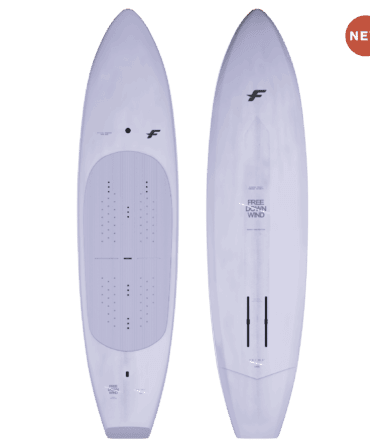
This is the structural purchase. A downwind board is long (7'2″ to 8'6″), narrow (17″ to 21″) and very voluminous for its width. Length gives you the paddling speed to take off; narrowness makes pumping efficient. Volume rule of thumb for beginners: your body weight in kilos plus 20 to 30 litres (80 kg → 100 to 110 L). Too small and you will not stand up; too big and the board sticks to the water on take-off.
Our F-ONE ROCKET SUP DW line covers every level: the standard construction for an affordable start, plus the PRO CARBON and COMP CARBON versions for riders chasing maximum responsiveness.
2. The foil
Downwind calls for a high-aspect front wing (aspect ratio 8 to 11): plenty of lift at low speed, long glide, high pumping efficiency. Rough guide by rider weight:
- 60-70 kg: 900 to 1,100 cm²
- 70-85 kg: 1,100 to 1,300 cm²
- 85 kg and up, or light wind: 1,300 to 1,600 cm²
Many beginners buy too small because they think in terms of performance. Downwind works the other way round: a big wing forgives line mistakes and keeps you flying through the holes between bumps. Our complete foils and the foils and masts section cover the full range.
3. The mast
An 85 to 100 cm high-modulus carbon mast is the standard. The extra length gives margin when the swell steepens and prevents breaching at the top of a bump. Stiffness matters more than weight: a soft mast turns every pump stroke into wasted energy.
4. The paddle
Carbon paddle, 80 to 90 in² blade, adjustable or three-piece so it fits in a bag. In downwind the paddle works for fifteen seconds per take-off — but those fifteen seconds decide the session.
Progression: the order that works
- Be able to fly. Downwind is not the discipline in which to learn foiling. Stable flight and clean pumping on a wingfoil come first.
- Learn to pump on flat water. Practise reconnects behind a wake or after a wing start: the goal is 15 to 20 seconds of flight with no traction.
- First runs with a wing. Take your downwind board out with a small wing. You learn to read bumps without the stress of the paddle take-off.
- The paddle take-off. This is the wall. It falls with wind (18 knots and up), a long enough board and a lot of repetition. Expect several sessions before your first clean flight.
- Long runs. Once you link the first 500 metres, progress becomes exponential: reading lines, turning in the bumps, saving energy.
Safety: what downwind changes
A downwind run is a one-way trip that takes you steadily away from your starting point, often into the middle of the lake. The basics:
- Never ride a new run alone. Take a partner, or a support boat.
- Flotation aid and board leash. On Lake Geneva a flotation aid is in fact mandatory beyond 300 m from shore in Geneva waters.
- Waterproof phone with shared location, or a VHF if you are going far.
- Choose your wetsuit for the water, not the air. Alpine lakes sit at 10-14 °C in May. See our wetsuits.
- Helmet and impact vest: masts and foil wings are sharp, and downwind crashes happen at constant speed.
- Keep your distances from scheduled boats, harbours (100 m on Vaud waters) and swimming areas.
What does it cost?
A complete, credible downwind setup lands between CHF 3,500 and 5,500: board CHF 1,600 to 2,400 depending on construction, complete foil CHF 1,200 to 1,900, paddle CHF 250 to 500, plus small gear. That is a serious budget — but a downwind board also serves for light-wind wingfoiling, pumping and SUP foiling, so it pays back across several disciplines. Our wingfoil and downwind range lets you build a coherent setup, and the second-hand section regularly carries tested gear.
Let's talk it through
Downwind is the discipline where the wrong gear choice costs the most in frustration. Before you order, tell us your weight, your wingfoil level and the lake you have in mind: we will tell you honestly whether you are ready, and what volume to start with. Shop in Neuchâtel, advice by phone or WhatsApp on +41 79 539 53 58.
Written in August 2026. Price ranges are indicative and reflect the models available at Elevatesurf on that date.